

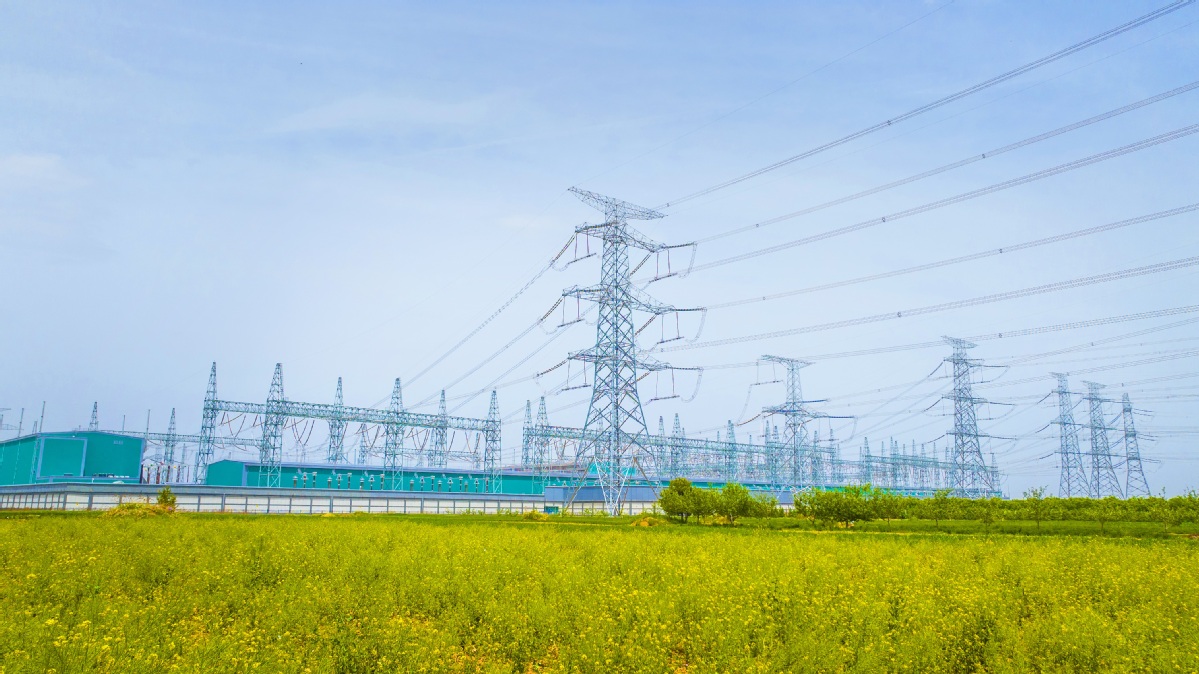
The Gansu-to-Shandong ±800 kV ultra-high voltage direct current transmission line originates from the Qingyang converter station in Gansu province. [Photo provided to chinadaily.com.cn]
The power line between Gansu and Shandong has linked resource-rich northwestern China with major power-consuming regions in the east, reshaping the country's power flow patterns and improving cross-regional energy allocation efficiency.
As a key corridor under China's West-to-East Power Transmission strategy, the Gansu-to-Shandong ±800 kV ultra-high-voltage direct current (UHV DC) transmission project is the country's first large-scale transmission line integrating wind, solar and thermal storage resources. It delivers electricity from Qingyang in Gansu province to Dongping in Shandong province, providing a stable large-scale electricity supply to eastern China while advancing the country's "dual carbon" goals.
Since its operation on May 8, 2025, the project has transmitted 28.8 billion kilowatt-hours of electricity, enough to power about 8 million three-person households for one year, according to State Grid Gansu Electric Power Company.
Using ±800 kV UHV DC transmission technology with a capacity of 8 million kilowatts, the project is the first UHV DC transmission line commissioned during the 14th Five-Year Plan period (2021-25), according to Zhang Jun, director of the main grid planning division at the company. It is also the country's first UHV DC project to achieve full-capacity operation in a single commissioning.
"After reaching full-capacity operation, this project will be able to transmit more than 36 billion kilowatt-hours of electricity from Gansu to Shandong annually, equivalent to about one-third of the annual power generation of the Three Gorges Dam," said Liu Kequan, director of the dispatching division at the State Grid Gansu Electric Power Dispatching Center.
Along the Bohai Bay coast in Shandong province, ports including Weifang, Binzhou and Dongying are using electricity transmitted from Gansu to support operations.
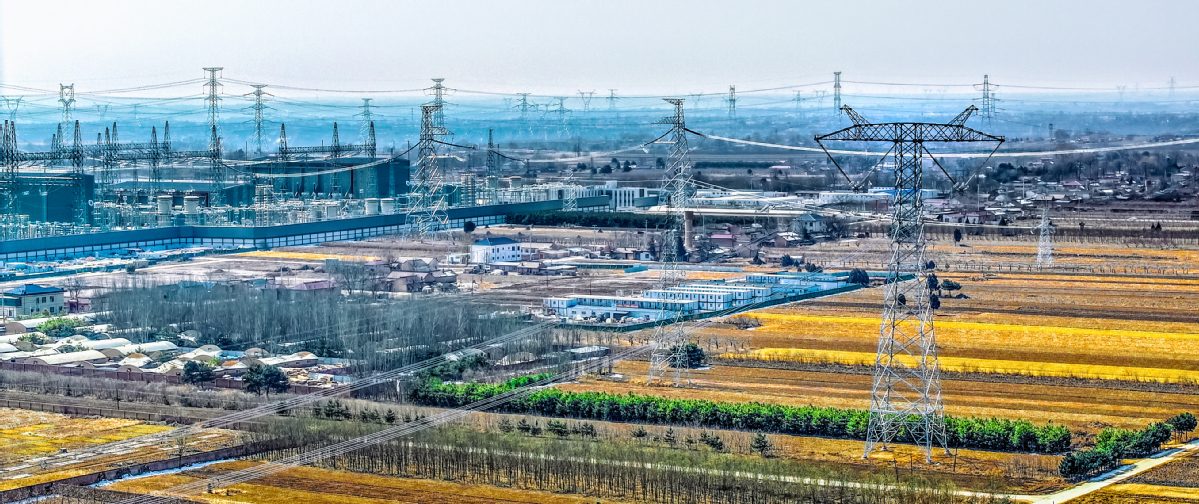
The Gansu-to-Shandong ±800 kV ultra-high voltage direct current transmission line has been in operation for more than one year. [Photo provided to chinadaily.com.cn]
"With electricity delivered from Gansu, we have greater confidence in the energy supply for port operations," said Han Guopeng, head of safety and operations maintenance at Shandong Port Energy Development Weifang Co. "In particular, green electricity has further strengthened Weifang Port's confidence in building a zero-carbon port."
Over the past year, the transmission corridor has supplied electricity to Beijing, Shanghai, Tianjin, Jiangsu and Zhejiang, helping ease power demand pressure in eastern China while expanding consumption channels for Gansu's renewable energy.
In November 2025, the line transmitted 290 million kilowatt-hours of green electricity to Shanghai within 10 days, helping ensure 100 percent renewable electricity use during the China International Import Expo.
According to State Grid Gansu Electric Power Company, more than 40 percent of the electricity transmitted over the past year came from new energy sources, equivalent to saving about 3.54 million tons of standard coal.
"Facing a UHV transmission system with a high proportion of new energy and bundled transmission of wind, solar, thermal power and storage, scientific coordination is key," said Liu Kequan.
"We have adopted a coordinated operating model featuring thermal power for peak regulation, renewable energy as the main supply source, and energy storage for support," Liu said. "By optimizing operating strategies in real time, we have achieved both stable thermal power supply and maximum renewable energy utilization."
The project has also accelerated the growth of Gansu's new energy industries. In Qingyang and Baiyin, large-scale wind, solar and storage projects have expanded rapidly, while manufacturers of wind turbines, storage systems and hydrogen equipment are scaling up production.
"Gansu has abundant renewable energy projects and strong market demand," said Mu Xinghui, a manager at Yishite Digital Equipment Manufacturing in Qingyang. "Producing here reduces transportation costs and allows companies to respond quickly to customer demand."
Gansu's installed new energy capacity has now exceeded 80 percent of its total installed power capacity, while the output value of its new energy industry has surpassed 100 billion yuan ($13.8 billion), as the province continues to transform its rich renewable resources into a driver of economic growth and China's low-carbon transition.
Source: By Hu Yumeng and Ma Jingna in Lanzhou, chinadaily.com, May 31, 2026
【https://www.chinadaily.com.cn/a/202605/31/WS6a1bfb43a310d6866eb4ba38_1.html】